Making the equipment work twice.
Growth brought larger capital requirements. On the telecommunications side, Amit recalls rising infrastructure costs, particularly for Canadian-made Nortel equipment, making it harder to compete while funding the next stage of expansion.
He created an equipment-leasing program for telecommunications companies, including Toronto’s Group Telecom and other startups, according to his account. Lease income helped offset the cost of acquiring the equipment. Buying in greater volume also helped him negotiate discounts and partnership agreements with manufacturers and software suppliers.
When lease periods ended and equipment returned, he could put that equipment to work in his own growing operations at a much lower effective cost. The model connected customer financing, purchasing power, equipment utilization and future infrastructure needs.
Buying equipment through the telecom downturn
During the dot-com downturn in the early 2000s, Amit recalls purchasing Group Telecom equipment and servers for approximately five cents on the dollar. This was another chapter in his approach to controlling equipment costs as market conditions changed.
The purchase price is part of Amit’s account. The retained Group Telecom presentations provide historical context about the company’s voice, data and application services.

Public historical context: Group Telecom entered creditor protection during the telecom downturn. CRTC historical record ↗
Explore equipment leasing today → · Explore current communications services →
Taking the leasing model beyond telecom.
Amit later extended leasing into other industries, including international transactions, where the underlying assets retained meaningful value. A financing capability developed around his own infrastructure needs had become a broader business offering.
The approach was to consider the equipment’s value alongside the customer’s need and the economics over the lease period. The specific assets, markets and agreements from this stage will be documented as further records become available.
Turning sleepless nights into a financing capability.
As recruitment and corporate accounts grew, individual invoices became much larger. Some startup customers were raising money month by month. Amit recalls sleepless nights worrying about whether clients would pay, even as the business continued winning work.
He developed his own factoring service with a non-recourse option, supported by insurance he reports arranging through the Lloyd’s of London market. His father’s knowledge of insurance helped him identify the opportunity to manage payment risk.
That capability also supported a different commercial proposition: in some engagements he could proceed without requiring a customer deposit and wait for payment. Amit recalls this helping him win business, negotiate better deals and enter additional markets where competitors had less flexibility to extend payment terms.
This is an account of the historical arrangement. Non-recourse protection applies only within the relevant agreement and insurance coverage, not to every reason an invoice may go unpaid. The historical account does not establish current coverage or a current relationship with an insurer.
Internal financing became a wider platform.
Amit describes this financing activity as beginning internally under Warner-Greem, then maturing into Sterling-Turner Corporation. Leasing and receivables finance grew from tools for supporting operating businesses into services that could help other clients grow.
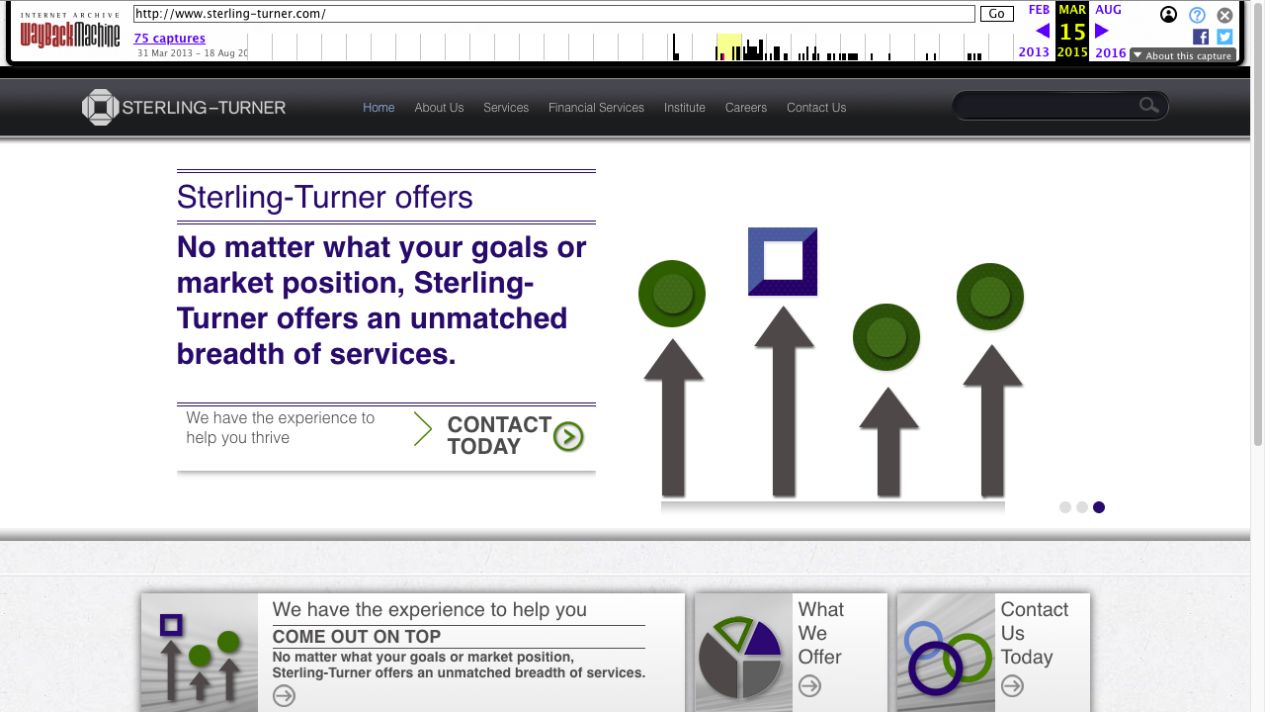
The archived Sterling-Turner website provides a later record of that broader positioning. Its March 2015 capture presents consulting, e-business, human capital, risk management and sales and marketing alongside a financial-services offering. Listed finance pathways include leases, purchase-order and inventory funding, accounts-receivable administration and invoice cash-flow advances.
This shows continuity with the mix of disciplines on the earlier Certex website, with financing made explicit. The archive supports the historical service positioning; the founder’s account supplies the earlier Warner-Greem-to-Sterling-Turner development.
Growing through a difficult market.
When the IT boom broke in 2001, Amit recalls continuing to grow by concentrating on operating economics and business needs. Office space and equipment became more affordable, and experienced sales and technology workers became available at lower hiring costs.
Companies still needed sales. In his experience, demand for call-center work remained strong, while his ability to support customer payment terms helped him pursue work that others could not finance as readily.
His account emphasizes the combination rather than a single advantage: control overhead, recruit capable people, acquire useful equipment and pair delivery with a workable financing model.
Companies still needed software delivered.
Amit observed an increase in companies seeking to outsource entire software projects as the wider IT market declined. He responded by hiring the people needed to take on that work.
The opportunity was to help clients deliver complete projects through an outside team. This added another way for the technology business to grow during the downturn, alongside call-center operations and financing capabilities.
The increase described here is Amit’s experience of demand in his business at that time, rather than a measured claim about the entire software industry.
Looking beyond the domestic market.
Fluctuations in the Canadian dollar also shaped Amit’s decisions. He describes moving into international trade and working with Export Development Canada as part of his effort to preserve and grow the value of the capital he had accumulated.
That experience extended the business perspective beyond domestic sales to cross-border opportunities, financing and risk. The particular EDC arrangements, transactions and dates will be added when supporting information is available.
This historical account does not imply a current EDC partnership, endorsement, guarantee or specified currency-protection product.
Experience that connects to today.
These chapters connect equipment ownership, customer payment needs, risk management, technology delivery and international trade. Current engagements are assessed separately under their own eligibility requirements and written terms.
The earlier chapters.
How we think: eight principles connected to this history →
Nexus Group, Certex Solutions, recruitment and the backup service →
The callback service and original flyer →
About this account
The leasing model, named historical customer, supplier arrangements, insurance experience, business evolution, downturn results and international-trade experience were supplied by Amit Kapoor. No transaction totals, profits, contract dates or continuing partnerships are inferred. References to Nortel, Group Telecom, Lloyd’s and Export Development Canada identify historical context and do not imply a current endorsement or affiliation. Additional records will be added as available.